Why Leaks Show Up on Your First Session Back After Time Off
Quick Answer: The pelvic floor works as part of a timing system with the diaphragm and deep abdominals, and timing degrades faster than strength does during a break. After one to three weeks off, the muscle has lost very little force but the automatic pre-contraction before impact is slower to fire. Add that comeback sessions are usually done at previous intensity rather than reduced intensity, and the first session back is the highest-risk session of the month. Ramp impact over two to three sessions and most of it resolves.
You trained for months without an issue. You took ten days off for a trip. The first session back, three minutes into skipping, it happened.
The muscle did not weaken that much in ten days. Something else did.

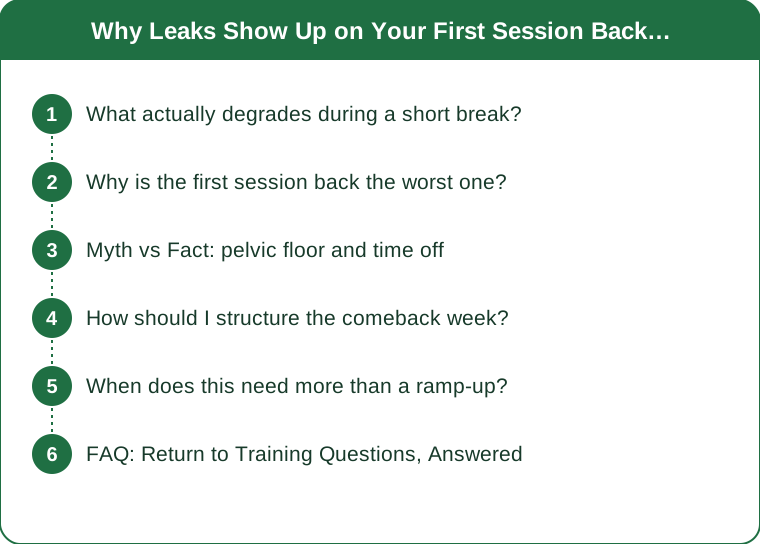
What actually degrades during a short break?
Not much strength. Meaningful strength loss in a trained muscle generally takes longer than two to three weeks of complete inactivity to show up in a measurable way.
What degrades quickly is coordination and timing. The pelvic floor’s most important job during impact is not a maximum contraction, it is a well-timed anticipatory one that fires slightly before the load arrives. That anticipatory pattern is a motor skill, and motor skills lose sharpness faster than muscles lose force.
There is also a breathing pattern component. Time off often means more sitting, shallower breathing and a less mobile ribcage, and the diaphragm and pelvic floor move as a coordinated pair. When one gets lazy, the timing of the other shifts.
So the comeback session presents an old load to a system with slightly newer, sloppier timing.
Why is the first session back the worst one?
Because of what people do on it, not just what changed in the break.
Intensity resumes where it left off. Almost nobody comes back at 60 percent. The plan says what it said three weeks ago, and the body meets it with three weeks of lost coordination.
Motivation is high. A comeback session is often harder than an average session because you feel like you have ground to make up.
Fatigue arrives sooner. Cardiovascular fitness does drop within two weeks, so you reach the fatigued state where leaks are most likely much earlier in the session than you expect.
And fatigue is the key variable. Leak risk rises substantially as the session progresses, because a tired pelvic floor loses timing before it loses strength. A session you would have finished cleanly when conditioned now spends its second half in the risk zone.
Myth vs Fact: pelvic floor and time off
Myth: If you leaked, your pelvic floor is weak. Fact: Leaks are frequently a coordination and timing problem, and some are caused by a pelvic floor that is too tense to release and recoil properly. More kegels is not a universal answer, and for an overactive pelvic floor it can make things worse.
Myth: Ten days off undoes months of work. Fact: It undoes some timing sharpness. The strength is still there. Most people are back to baseline within two or three sessions.
Myth: You should push through and it will sort itself out. Fact: Repeatedly training in the leaking state reinforces the poor timing pattern. Reduce the impact until you are dry, then rebuild.
Myth: Emptying your bladder right before helps. Fact: A completely empty bladder is not necessarily better, and habitually going just in case can gradually reduce your functional bladder capacity over time.

How should I structure the comeback week?
Ramp impact specifically, not just overall volume. Impact is the variable that matters here.
-
Session one: no impact. Strength work, controlled tempo, no jumping or skipping. Add three to five minutes of connection work: slow diaphragmatic breathing with a gentle pelvic floor contraction on the exhale, release fully on the inhale.
-
Session two: low impact. Marching, step-ups, light bounding. Roughly 25 percent of your usual impact volume.
-
Session three: half impact. Skipping or running at half your normal duration, placed at the start of the session while you are fresh.
-
Session four: normal. If sessions one to three were dry.
Place impact early, always. Moving jumps or skipping to the start rather than the end of a session is one of the highest-value changes available, because it happens before fatigue arrives.
Breathe out on effort. Holding your breath spikes intra-abdominal pressure at exactly the moment the floor is being asked to manage it.
When does this need more than a ramp-up?
A short comeback wobble is common and usually resolves. Some patterns are worth taking to a pelvic health physiotherapist rather than managing alone:
- Leaks that continue past three or four sessions of graded return
- Leaks at low intensity or at rest, not only under impact
- Urgency that you cannot defer, rather than leakage on impact
- A feeling of heaviness or dragging in the pelvis
- Pain with intercourse, tampon use or exercise
- Anything that started after a birth, surgery or a new medication
Pelvic health physiotherapy is a specific field, and an assessment answers the question that matters most, which is whether the floor is underactive, overactive or simply mistimed. Those three need different programmes, and guessing wrong wastes months.
This is general information, not medical advice. See a pelvic health professional for symptoms that persist.
FAQ: Return to Training Questions, Answered
How long can I take off before this becomes likely?
Many people notice it after as little as seven to ten days, and most notice it by three weeks. Duration matters less than how hard the comeback session is.
Do kegels during the break prevent it?
A couple of minutes daily of coordinated breathing and contraction maintains the timing pattern well and takes almost no effort. Maximum-effort holds are less useful than well-timed light ones.
Does running or jumping matter more?
Jumping and skipping produce higher and faster peak forces, so they expose timing problems first. Running exposes them later, through accumulated fatigue.
Is it worse in hot weather?
Often slightly, because dehydration concentrates urine and can irritate the bladder. Drink normally rather than restricting, since restricting is a common and counterproductive response.
This is general information, not medical advice.
TL;DR:
- Short breaks cost timing and coordination, not strength, and timing is what prevents impact leaks.
- The comeback session is riskiest because intensity resumes at old levels while fatigue arrives sooner.
- Ramp impact specifically over three sessions, and place jumping early while you are fresh.
- Persistent leaks, urgency, heaviness or pain deserve a pelvic health physiotherapist, not more kegels.
A leak on the first session back is information about timing, not a verdict on your pelvic floor. Give the coordination two or three sessions to catch up with the strength that never left, and the problem usually resolves itself.
Keep Reading
This article is for general informational purposes only and is not medical advice. Always consult a qualified health professional for guidance specific to you.