Why You Leak When You Sneeze, and the Timing Fix Nobody Teaches
Quick Answer: A cough or sneeze creates a pressure spike faster than a slow reflex can respond to. The technique for this is called the knack: a deliberate pelvic floor contraction a fraction of a second before the cough, sneeze, or lift. Trials have shown meaningful reductions in leakage from the timing alone, before any strength gain. Practice it on voluntary coughs several times a day until it becomes automatic, and pair it with strength work rather than choosing between them.
Most advice for leaking with a sneeze is some version of do more Kegels. That may well be part of it, and it misses the more immediately fixable problem.
A sneeze produces a very large abdominal pressure spike in a very short time. Strength determines how much your pelvic floor can resist. Timing determines whether it is contracted when the spike arrives.

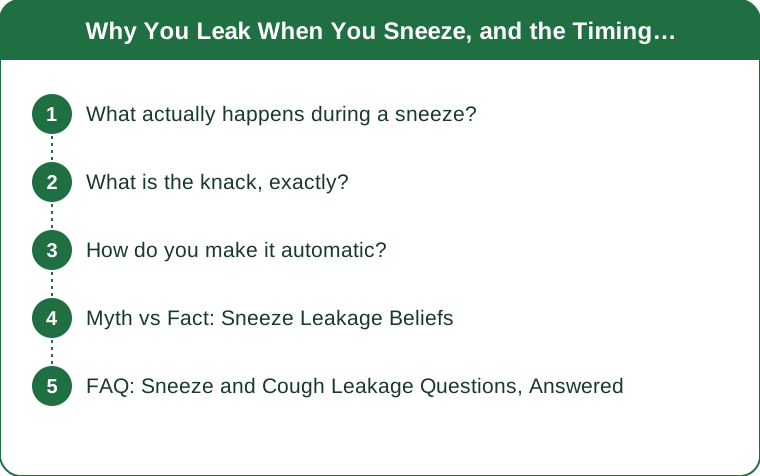
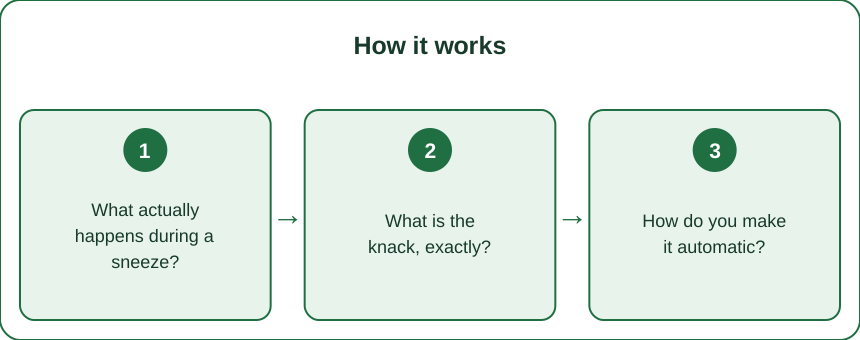
What actually happens during a sneeze?
Intra-abdominal pressure rises sharply and quickly, and the pelvic floor has to be pre-contracted to counter it.
In a body where the reflex works well, the pelvic floor and deep abdominal muscles contract slightly before the pressure event, in anticipation. This is called feed-forward activation, and it happens without conscious thought.
When that anticipatory timing is disrupted, common after pregnancy, surgery, prolonged high-impact loading, or a long period of pelvic floor guarding, the contraction arrives late. The pressure spike has already peaked before the support is in place.
Why this matters practically: a late strong contraction fails where an on-time moderate contraction succeeds. That is why some people with reasonable measured strength still leak, and why strength-only programs sometimes disappoint.
The associated pattern: many people who leak with sneezing also report leaking with laughing, a sudden lift, or the first step of a run. These share the same signature, a fast pressure rise that outpaces a delayed response.
What is the knack, exactly?
A voluntary pelvic floor contraction performed immediately before and held through a known pressure event.
It was described in the physiotherapy literature and studied specifically for stress incontinence, with trials showing substantial reductions in leakage on coughing from the timing technique alone, without waiting for strength gains.
How to do it:
- Feel the sneeze or cough coming, which is usually a half second of warning and enough
- Lift and squeeze the pelvic floor, the sensation of stopping wind and drawing up, moderately firmly. Not maximally.
- Hold through the cough or sneeze
- Release afterwards, fully
Key details people get wrong:
- Moderate, not maximal. A maximal effort tends to recruit the wrong muscles, hold the breath, and push down. Aim for around 50 to 70 percent.
- Do not hold your breath. Breath holding raises abdominal pressure further, working against you.
- Do not clench the glutes or thighs. Those substitutions feel like effort and do not close the urethra.
- Release fully afterwards. A pelvic floor that never releases becomes overactive, which causes a separate set of problems.
For lifting rather than sneezing: same principle, applied before you take the weight, and held through the effort. This is the version that transfers directly to the gym.

How do you make it automatic?
Practice it on events you can predict, then on events you can anticipate slightly, then let it generalize.
Week 1 to 2, voluntary practice:
- Do a deliberate cough 5 times, contracting just before each one, three times a day
- Same with a deliberate throat clear
- Add before standing up from a chair, which is a smaller pressure event and easy to remember
Week 2 to 4, anticipated events:
- Before lifting anything, from a laundry basket to a barbell
- Before the first step of a run
- Before a laugh, when you can feel one coming
Week 4 onward, real sneezes. By this point the pattern usually starts appearing on its own, which is the goal. Feed-forward activation is a motor pattern, and motor patterns automate with repetition.
Alongside this, do the strength work. Timing without capacity has a ceiling. A typical starting program is 8 to 12 contractions held 3 to 8 seconds with equal rest, three sets daily, plus 10 quick flicks. Progress the hold duration, not the number of sets.
Realistic timeline: the timing technique often shows benefit within days to weeks. Strength changes take 8 to 12 weeks minimum, and up to 6 months for full effect. Both are worth starting today.
The other half of the equation: posture and breathing. A habitually braced abdominal wall or a rib cage held down raises baseline pressure on the pelvic floor. If you are gripping your abs all day, that matters as much as any exercise.
Myth vs Fact: Sneeze Leakage Beliefs
Myth: Leaking with a sneeze just means you need more Kegels. Fact: Strength is often part of it, and timing is frequently the more immediately fixable factor. Trials of the knack show reduced leakage before any strength change occurs.
Myth: Leaking is inevitable after having children. Fact: Common, not inevitable, and not something to accept without assessment. A large majority of stress incontinence responds well to supervised pelvic floor training.
Myth: You should stop the flow midstream to practice. Fact: Do not use this as an exercise. It can interfere with normal bladder emptying. As a one-off way to identify the muscles, once, it is acceptable. As practice, no.
Myth: Squeezing as hard as possible is best. Fact: Maximal effort recruits glutes, adductors, and breath holding, which raises abdominal pressure. Moderate and well-timed beats maximal and late.
Myth: If Kegels have not worked, nothing will. Fact: A large share of people perform them incorrectly without knowing, often bearing down rather than lifting. An assessment with a pelvic health physiotherapist frequently identifies the issue in one session, and it is the highest-value step available if you have been trying without progress.
Myth: An overactive pelvic floor cannot leak. Fact: It can, and this is why more squeezing sometimes makes things worse. A muscle held short and tight has poor control and poor endurance. If you have pain with intercourse, difficulty starting a stream, or constant tension, this is worth assessing before adding contractions.
This is general information, not medical advice. New leakage, leakage with pain, blood in urine, or any sudden change should be evaluated by a clinician.
FAQ: Sneeze and Cough Leakage Questions, Answered
Why do I leak when I sneeze but not otherwise?
A sneeze creates a very fast pressure spike, and if your pelvic floor contracts a fraction of a second late, the support is not in place when the pressure peaks. Slower pressure rises give the reflex time to respond.
What is the knack technique?
A deliberate moderate pelvic floor contraction performed just before a cough, sneeze, or lift, and held through it. Practice on voluntary coughs several times a day until it becomes automatic.
How long until pelvic floor training works?
The timing technique can help within days to weeks. Genuine strength changes take 8 to 12 weeks at minimum, with continued improvement over several months. Do both.
TL;DR:
- Sneeze leakage is often a timing problem, not just a strength problem. The contraction arrives after the pressure spike.
- The knack is a moderate pelvic floor contraction just before and through the cough, sneeze, or lift. Trials show it reduces leakage on its own.
- Moderate effort, no breath holding, no glute clenching, and full release afterwards.
- Practice on voluntary coughs and before standing or lifting until it automates, and run strength work alongside it.
If you have been doing Kegels without progress, an assessment with a pelvic health physiotherapist is the highest-value next step. Many people are doing them wrong in a way that is easy to correct once someone checks.
Keep Reading
This article is for general informational purposes only and is not medical advice. Always consult a qualified health professional for guidance specific to you.