Does Hydration Timing Change Leak Risk During a Workout?
Quick Answer: Timing helps; restriction does not. Stopping fluids 60 to 90 minutes before training and emptying your bladder shortly before you start meaningfully reduces leak risk. Drinking less overall makes things worse - concentrated urine irritates the bladder lining, increases urgency, and over time reduces functional bladder capacity. The practical protocol is normal daily hydration, front-loaded earlier in the day, with a taper in the last hour and a proper void before starting.
Underneath the timing, leaks during exercise are a pressure-and-support problem, which is why the timing helps but does not solve it.

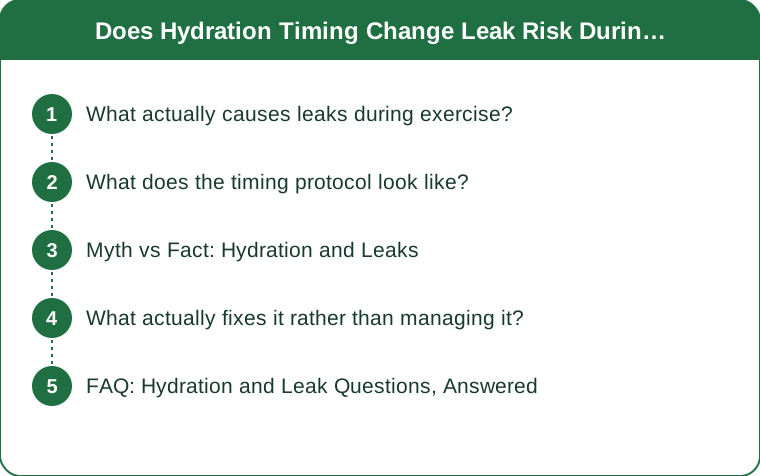
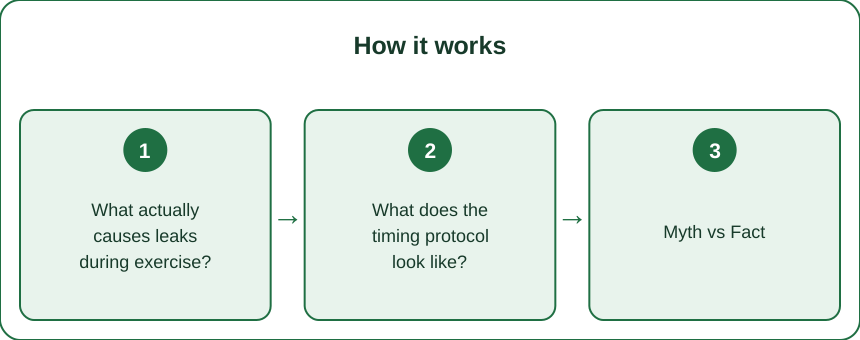
What actually causes leaks during exercise?
A mismatch between downward pressure and the support underneath it.
Stress urinary incontinence is the most common form in exercise - leaking during impact, jumping, lifting, coughing, or sneezing. It happens when intra-abdominal pressure exceeds the closing pressure of the urethra, and the pelvic floor is a central part of that closing mechanism.
Impact multiplies bodyweight forces. Running generates ground reaction forces of roughly 2 to 3 times bodyweight, and jumping considerably more. That force travels up and lands on the pelvic floor several hundred times per session.
Bladder volume changes the equation directly. A fuller bladder means more volume to displace and more pressure on the same support structure. This is why timing genuinely helps - it is reducing one variable in a pressure equation.
Breath holding raises pressure sharply. Holding the breath through a lift or a hard effort increases intra-abdominal pressure substantially. Exhaling on exertion is one of the more effective free interventions available.
And this is common, not rare. Prevalence estimates in active women vary widely but are consistently high, with particularly high rates in high-impact sports. Common does not mean normal or untreatable - it means there is a well-established path to improvement.
What does the timing protocol look like?
Four steps, in order.
1. Hydrate normally through the day, front-loaded. Roughly 30 to 35ml per kg of body weight across the day for most people, with the majority consumed before mid-afternoon. Front-loading means you arrive at an evening session well hydrated but not currently processing a large volume.
2. Taper in the last 60 to 90 minutes. Small sips rather than a large glass. This is the actual timing intervention and it is the piece most people get wrong in both directions.
3. Empty your bladder 10 to 15 minutes before starting - not 45 minutes before, and not while rushing out the door. Take the time to empty fully; a rushed partial void leaves you starting with more volume than you think.
4. Drink during the session as needed. Do not train dehydrated. Sipping during exercise rarely reaches the bladder fast enough to matter for a session under about 90 minutes.
What not to do: double voiding, hovering, or straining. Going just in case repeatedly teaches the bladder to signal at lower volumes and reduces functional capacity over months. Hovering over a toilet seat prevents the pelvic floor from relaxing fully, which leaves residual volume behind.

Myth vs Fact: Hydration and Leaks
Myth: Drinking less prevents leaks. Fact: Concentrated urine is a bladder irritant. Restriction increases urgency and frequency and reduces functional capacity, making the underlying problem worse over weeks.
Myth: You should go to the toilet just in case before every session. Fact: Once, shortly before, is appropriate. Habitual just-in-case voiding retrains the bladder to signal early and is a well-documented driver of urgency.
Myth: Caffeine has no real effect. Fact: Caffeine is a recognised bladder irritant and a mild diuretic. A large coffee an hour before a high-impact session is a genuinely poor combination, and moving it earlier is a cheap experiment worth running.
Myth: Leaks mean you should stop running or jumping. Fact: Avoidance is not the treatment. Pelvic floor muscle training has strong evidence for improving stress incontinence, and most women return to high-impact activity with appropriate rehabilitation.
Myth: It is only a postpartum problem. Fact: It is common postpartum and also affects women who have never been pregnant, particularly in high-impact sport, and increases around menopause with the drop in oestrogen. Age and childbirth are risk factors, not requirements.
What actually fixes it rather than managing it?
Training the support structure, with the same seriousness as any other muscle.
Pelvic floor muscle training is the first-line evidence-based treatment. A typical programme involves 3 sets of 8 to 12 contractions daily, holding each for 6 to 8 seconds, plus a set of quick contractions. Give it 12 weeks - this is a strength adaptation and it follows strength timelines.
Technique matters more than volume. A significant proportion of women perform pelvic floor contractions incorrectly when working from written instructions alone, frequently bearing down instead of lifting. A single session with a pelvic health physiotherapist is the highest-value thing in this entire article, because it confirms you are training the right thing.
Coordinate with the breath. Exhale and engage on the effort - as you stand from a squat, as you land, as you lift. Breath holding at high pressure is the pattern most commonly associated with leaks in the gym.
Do not neglect the rest of the system. Hip, glute, and deep abdominal strength all contribute to pressure management. Isolated pelvic floor work in a body that is otherwise weak is only part of the answer.
Modify temporarily rather than stopping. Reduce impact while you build - swap running for cycling or swimming, jumping for step-ups - and reintroduce gradually. Continuing to leak repeatedly through sessions is not building tolerance.
And practical support helps in the meantime. High-rise, supportive training leggings, dark colours, and purpose-made absorbent underwear or liners remove the anxiety that makes people avoid training altogether. Managing the symptom while you treat the cause is entirely reasonable and it keeps you in the gym long enough for the rehabilitation to work.
This is general information, not medical advice. Leaking urine during exercise is common but not something you have to live with - a pelvic health physiotherapist or your doctor can assess and treat it, and outcomes with proper treatment are good.
FAQ: Hydration and Leak Questions, Answered
How long before exercise should I stop drinking?
Taper in the last 60 to 90 minutes with small sips only, and empty your bladder 10 to 15 minutes before starting. Do not restrict fluids across the day.
Does dehydration make leaks worse?
Yes, over time. Concentrated urine irritates the bladder lining and increases urgency, and chronic restriction reduces functional bladder capacity.
Should I avoid coffee before training?
Caffeine is a known bladder irritant, so shifting it earlier in the day is a worthwhile experiment. Two weeks of change is enough to tell whether it matters for you.
Will pelvic floor exercises alone fix it?
For many women with stress incontinence, supervised pelvic floor muscle training produces significant improvement or resolution over about 12 weeks. Correct technique is the deciding factor, which is why an assessment is worth it.
Is it normal to leak during high-impact exercise?
It is common, particularly in high-impact sport, but common is not the same as normal or inevitable. It responds well to treatment and is worth raising with a professional rather than working around.
TL;DR:
- Timing helps, restriction harms. Hydrate normally and front-load it; taper in the last 60 to 90 minutes and empty your bladder 10 to 15 minutes before starting.
- Concentrated urine irritates the bladder and chronic restriction reduces functional capacity - drinking less makes the underlying problem worse.
- Skip just-in-case voiding and hovering; both retrain the bladder unhelpfully.
- The real fix is pelvic floor muscle training over about 12 weeks with correct technique, plus exhaling on exertion and building hip and deep abdominal strength.
Timing buys you a better session today. The training buys you the next ten years of sessions - and a single appointment with a pelvic health physiotherapist to confirm your technique is the highest-return thing on this list.
See It in Motion
Seen here: Maternity Capris with Side Pockets — shop it on bubblelime.com
Keep Reading
This article is for general informational purposes only and is not medical advice. Always consult a qualified health professional for guidance specific to you.