How to Wash Leakproof Underwear So It Actually Keeps Working
Quick Answer: Leakproof underwear fails early for laundry reasons, not fabric reasons: fabric softener coats the absorbent core and destroys its wicking, high dryer heat degrades the waterproof membrane, and skipping the cold pre-rinse lets proteins set into the fibres. The routine that preserves the tech is short - cold rinse until the water runs clear, machine wash cold-to-warm in a mesh bag with regular detergent, no softener ever, hang to dry. Cared for this way, a good pair performs for two to three years; softened and hot-dried, the same pair starts wicking badly and smelling permanently within months.
The pair that never let you down is suddenly letting you down. Before you blame the brand, look hard at the laundry routine - that is where most leakproof underwear actually dies.
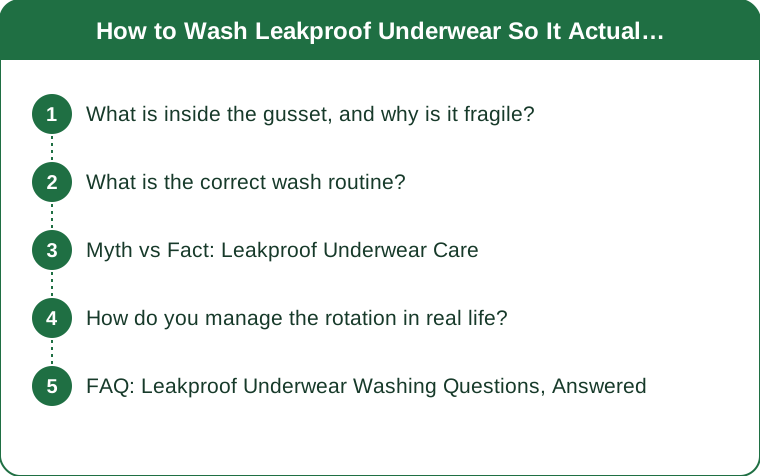
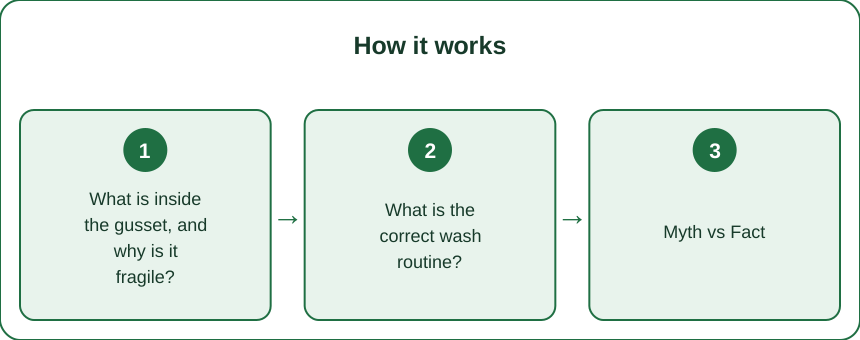
What is inside the gusset, and why is it fragile?
Understanding the layers explains every rule that follows.
Layer one: the wicking surface. The fabric against your skin is engineered to pull moisture away fast and feel dry. Its job depends on fibre surfaces staying clean and uncoated - anything filming over them stops the pull.
Layer two: the absorbent core. Beneath sits the reservoir - dense fibres that hold several teaspoons of liquid distributed through their structure. It needs open pathways; residue clogs it exactly the way it clogs a towel.
Layer three: the leakproof membrane. The outermost tech layer is a thin waterproof-breathable film that stops moisture reaching your leggings. It is polymer, and polymers age fastest with heat - every hot dryer cycle stiffens and micro-cracks it a little.
The system is a one-way street. Skin-side in, spread through the core, blocked by the membrane. Every care mistake breaks one specific stage: softener kills the pull, residue clogs the reservoir, heat cracks the wall.
Elastic is the quiet fourth component. The leg and waist elastics create the seal that makes the absorbency matter. Cooked elastic means gapping at the leg opening, and a gapping pair leaks at the edges no matter how healthy the core is.
None of this is delicate in normal use - the layers survive wearing, moving, and workouts fine. The vulnerabilities are almost entirely in the wash, which is why two identical pairs can have wildly different lifespans in two different households.
What is the correct wash routine?
Four steps, less effort than it reads, and it becomes automatic within a cycle.
Step 1: cold rinse, soon, until clear. Rinse under cold running water - squeezing gently, never wringing hard - until the water runs clear. Cold matters: warm water sets protein stains into fibres. Soon matters too; a pair rinsed the same day washes clean forever, a pair left dry for days fights you.
Step 2: machine wash cold or warm, in a mesh bag. Regular detergent, normal cycle, with the rest of your dark laundry - no special load needed. The mesh bag is not preciousness: it stops hooks and zips abrading the membrane and keeps the elastics from stretching around the drum.
Step 3: the never list. No fabric softener - it is designed to coat fibres, which is precisely the disease here. No dryer sheets, same mechanism. No chlorine bleach, which attacks both membrane and elastic. No heavy-duty sanitize cycles, which are just heat by another name.
Step 4: hang dry, always. Over a rail or flat, away from radiators and direct summer sun. Drying takes longer than regular underwear because the core holds water - overnight is typical. The dryer is the single biggest lifespan variable: skip it and the membrane and elastics age years slower.
If you must speed things up, roll the pair in a dry towel and press, then hang. And buy enough pairs that drying time never forces a shortcut - the rotation that lets every pair air-dry fully is cheaper than replacing cooked pairs annually.
Detergent dose matters more than brand: too much leaves residue the core has to carry. Use the low end of the scoop for a normal load.
Myth vs Fact: Leakproof Underwear Care
Myth: They need special detergent. Fact: Regular detergent at a modest dose is exactly right. The special products to worry about are the ones you must avoid - softener, sheets, bleach - not ones you need to buy.
Myth: Hot water washes them cleaner. Fact: Hot water sets protein stains, stresses elastic, and adds nothing detergent is not already doing. Cold-to-warm cleans fully once the pre-rinse has done its job.
Myth: The dryer on low is fine. Fact: Even low cycles run hot enough, long enough, to age the membrane and elastic - and low-heat cycles run longer to compensate. Hang drying is the difference between a two-year pair and an eight-month pair.
Myth: A persistent smell means the pair is worn out. Fact: Usually it means residue - softener film or detergent overdose trapping bacteria in the core. A few correct washes, or one soak in warm water with a cup of white vinegar followed by a normal cold wash, often fully resets a smelly pair.
Myth: Leaking means the absorbency failed. Fact: More often the pair still absorbs fine but has lost its seal - stretched leg elastics gapping under movement - or its wicking surface is coated and moisture sits on top instead of soaking in. Diagnose before replacing: edge leaks are elastic, surface wetness is coating, actual strike-through is the membrane.
Myth: Washing after every single wear wears them out faster. Fact: Correct washing is gentle; wearing unwashed is not. Every wear deposits what the core is designed to trap, and letting it sit is what breeds the permanent smell. Wash every wear, correctly.
How do you manage the rotation in real life?
The routine only survives if it fits actual weeks - gym bags, travel, heavy days.
Own enough for your true cycle. Count your heaviest stretch plus two drying days: for most people that lands at five to eight pairs. Under-buying is the hidden cause of dryer use and skipped rinses - the rotation should never depend on tonight’s laundry heroics.
Solve the away-from-home rinse. At the gym or office, a quick cold rinse in a sink and a wet-bag in your tote keeps the same-day rule alive. Travel kits are just a wet bag, a hotel sink, and a shower rail - leakproof pairs are famously the best travel underwear precisely because they sink-wash well.
Pair them smartly with workouts. Under high-waisted leggings for training, the leakproof pair replaces both regular underwear and the what-if worry - but sweat-heavy sessions count as a wear, and the post-gym rinse matters double because sweat salts build residue too.
Give them a monthly deep-clean slot. One warm-water vinegar soak followed by a normal wash strips accumulated residue before it becomes smell. Mark it to the first of the month and it actually happens.
Watch the three retirement signs: leg elastics that no longer sit flush, wicking that leaves surface wetness after a correct wash, or dampness reaching the outside. Elastic failure and membrane strike-through are terminal; surface coating is usually fixable with the reset soak.
And stagger purchases. Buying the whole drawer at once means the whole drawer retires at once. Adding a pair or two each season keeps a mix of ages so the rotation never collapses in a single month.
FAQ: Leakproof Underwear Washing Questions, Answered
Can I put leakproof underwear in the dryer?
You can, and it is the main reason pairs die early - heat ages the waterproof membrane and cooks the leg elastics that create the seal. Hang dry overnight instead, and buy enough pairs that drying time is never a problem.
Why does my period underwear smell even after washing?
Almost always residue: fabric softener film or excess detergent trapping bacteria in the absorbent core. Cut the softener permanently, halve the detergent, and reset the pair with a warm vinegar soak followed by a normal cold wash.
Do I need to rinse before machine washing?
Yes - a cold rinse until the water runs clear is the highest-value step in the whole routine. It stops stains setting, keeps the core clear, and lets the pair wash clean in an ordinary cold cycle with the rest of your laundry.
Why is my leakproof underwear suddenly leaking?
Diagnose the location. Edge leaks mean stretched elastics - usually dryer damage. Surface wetness that will not soak in means a coated wicking layer - usually softener. True strike-through means the membrane has aged out. Only the last one is unfixable.
How long should leakproof underwear last?
With cold washes, no softener, and hang drying: roughly two to three years of regular rotation. With hot dryers and softener: often under a year. Care, more than brand, sets the lifespan.
TL;DR:
- Cold rinse until clear, same day; then a normal cold machine wash in a mesh bag.
- Never fabric softener, dryer sheets, bleach, or the tumble dryer - those four kill the tech layers.
- Hang dry overnight and own enough pairs that the rotation never needs shortcuts.
- Smell means residue, not death: vinegar soak and a correct wash usually reset it.
- Leaks at the edges are elastic, surface wetness is coating, strike-through is retirement.
The pair does its job every wear; the laundry decides for how many years. Wash cold, hang dry, skip the softener - that is the entire secret.
See It in Motion
Seen here: Super High Waist Embossed Yoga Leggings with Inner Pocket — shop it on bubblelime.com
Keep Reading
This article is for general informational purposes only and is not medical advice. Always consult a qualified health professional for guidance specific to you.