Jump Rope Workouts and the Pelvic Floor: What to Know Before Adding Them Back In
Quick Answer: Jump rope is genuinely one of the higher-impact activities for pelvic floor stress because of its repetitive vertical loading, but it’s not automatically off-limits — building pelvic floor strength and coordinated breathing technique first, starting with low-rebound variations, and paying attention to any leaking as direct feedback all make it possible to reintroduce jump rope more safely rather than avoiding it indefinitely.
Jump rope gets recommended constantly for quick cardio, and just as often quietly avoided by people managing pelvic floor symptoms who assume it’s simply off the table for good.

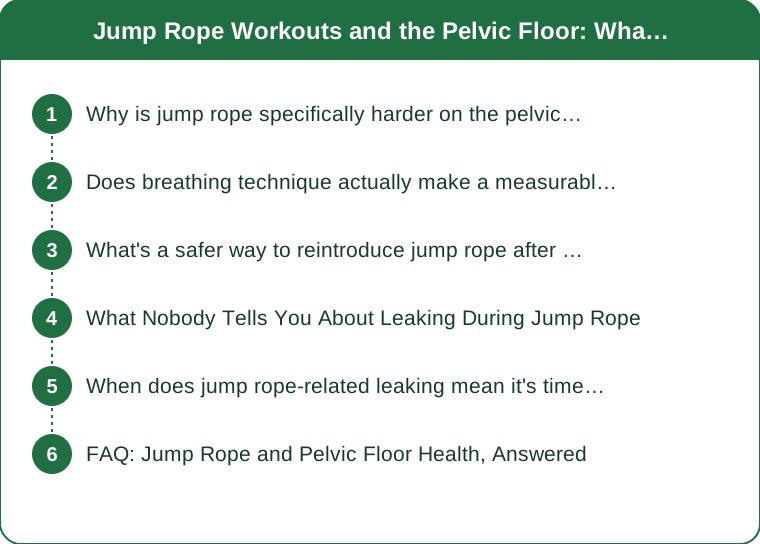
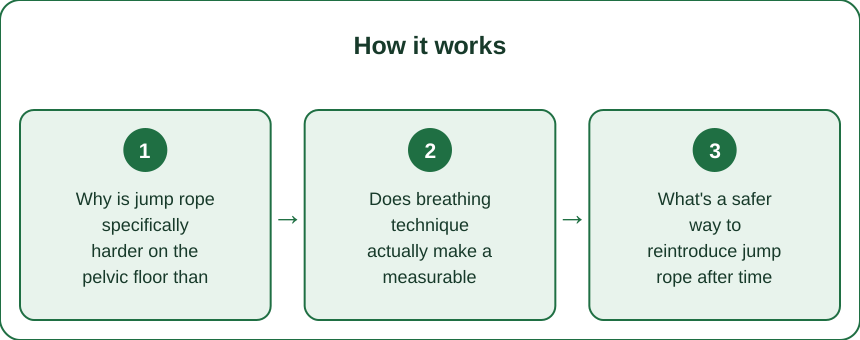
Why is jump rope specifically harder on the pelvic floor than other cardio?
The pelvic floor absorbs impact with every single landing, and jump rope involves a very high number of repetitive small jumps in a short time — often 100+ per minute — compared to something like walking or cycling, which has far less vertical impact per minute. This repetition, not any single jump’s intensity, is what makes it a higher-risk activity for leaks specifically.
Does breathing technique actually make a measurable difference here?
Yes — exhaling on the landing, rather than holding breath through impact, helps the pelvic floor engage in coordination with the diaphragm instead of being caught unprepared by sudden downward pressure. Many people who leak during jump rope are unconsciously holding their breath through each landing, adding unmanaged intra-abdominal pressure on top of the impact itself.
What’s a safer way to reintroduce jump rope after time away or postpartum?
Starting with lower-rebound variations — a light bounce with minimal height, or a slower cadence with fewer total jumps per set — lets the pelvic floor build tolerance gradually rather than jumping straight back into a full-intensity session. Short sets (30-60 seconds) with rest in between, rather than several continuous minutes, is a reasonable early progression.

What Nobody Tells You About Leaking During Jump Rope
Leaking during jump rope, even occasionally, is common enough that it’s not automatically a sign something is seriously wrong — but it is direct, useful feedback that current pelvic floor capacity hasn’t caught up to the activity’s demand yet. Treating it as information to adjust around, rather than either ignoring it completely or panicking and quitting jump rope forever, is the more useful middle path.
When does jump rope-related leaking mean it’s time to stop and get it checked?
Leaking that’s frequent, worsening, or accompanied by pelvic pressure or pain is worth having evaluated by a pelvic floor physical therapist or doctor rather than continuing to push through it — this is general information, not medical advice, and persistent symptoms deserve a professional assessment specific to the individual.
FAQ: Jump Rope and Pelvic Floor Health, Answered
Is it necessary to fully avoid jump rope while rebuilding pelvic floor strength?
Not necessarily — modifying intensity, duration, and rebound height often allows some form of jump rope to continue while strength rebuilds, rather than requiring complete avoidance.
Do certain jump rope styles put less strain on the pelvic floor than others?
Lower-impact variations, like a light bounce or a single-foot alternating step rather than a full two-foot jump, generally reduce pelvic floor demand compared to high-rebound, fast-paced jump rope styles.
How long does pelvic floor strength typically take to rebuild enough for full-intensity jump rope?
This varies widely by individual history and starting point, but many people work with a pelvic floor specialist over a period of weeks to months rather than expecting an immediate return to full-intensity training.
TL;DR:
- Jump rope’s repetitive impact makes it genuinely higher-risk for pelvic floor stress than most cardio
- Exhaling on landing, rather than holding breath, helps the pelvic floor manage the impact
- Starting with low-rebound, short-set variations builds tolerance gradually and safely
- Frequent or worsening leaking is worth a professional evaluation, not just pushing through
Jump rope doesn’t have to be permanently off the table — it just needs a more gradual, breath-aware reintroduction than jumping straight back into a full session. This is general information, not medical advice.
Keep Reading
This article is for general informational purposes only and is not medical advice. Always consult a qualified health professional for guidance specific to you.