The Breathing Technique That Actually Strengthens Your Pelvic Floor
Quick Answer: Exhale as you contract your pelvic floor, inhale as you release. Your diaphragm and pelvic floor move together like a piston — both descend on the inhale and lift on the exhale — so contracting on the exhale works with that movement instead of against it. Holding your breath during a Kegel raises intra-abdominal pressure downward, actively fighting the lift you’re trying to create.
You’ve been told to do your Kegels. Squeeze, hold, release, repeat. Ten times, three sets a day.
What almost nobody mentions is what your breath should be doing while you squeeze. And that omission matters more than the squeeze itself — because if you hold your breath, which is most people’s instinct, you’re pushing down at the exact moment you’re trying to lift.

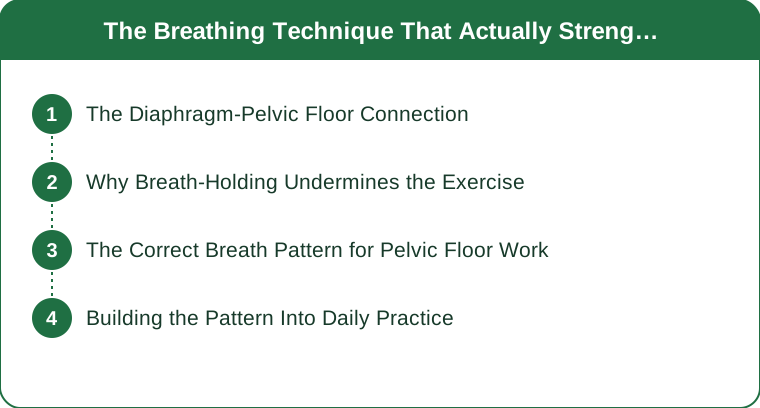
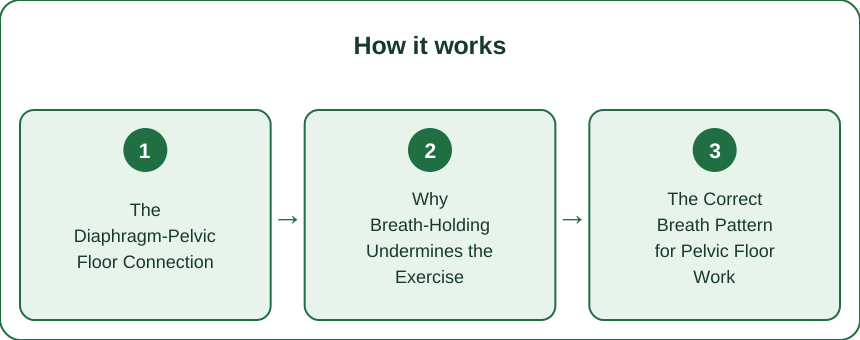
How Are the Diaphragm and Pelvic Floor Connected?
They’re the top and bottom of the same pressurized canister.
Picture your torso as a cylinder. The diaphragm is the lid. The pelvic floor is the base. Your deep abdominals and multifidus form the walls. That whole structure manages pressure as a unit, and the top and bottom move in sync — a relationship physical therapists call the piston mechanism.
Here’s the sequence with a normal breath:
- Inhale: the diaphragm contracts and moves down. Pressure in the abdomen rises. The pelvic floor lengthens and descends slightly — maybe a few millimeters. This is normal, healthy, and not something to resist.
- Exhale: the diaphragm relaxes and moves up. Pressure drops. The pelvic floor naturally recoils and lifts.
That gentle descend-and-lift happens roughly 20,000 times a day whether you think about it or not. Which means the question isn’t whether your breath affects your pelvic floor — it’s whether you’re going to use that connection or fight it.
Why Does Holding Your Breath Ruin a Kegel?
Because breath-holding creates exactly the opposite pressure to the one you want.
When you hold your breath and bear down — even slightly, even unintentionally — you’re performing a mini Valsalva maneuver. Intra-abdominal pressure spikes and pushes downward onto the pelvic floor. Meanwhile you’re trying to lift that same tissue upward.
You end up with two forces cancelling each other out, and often a third problem: many people, unable to feel a real lift, start recruiting glutes, inner thighs, and abs instead. That’s straining, not engaging. It feels like effort, which is why it’s so easy to mistake for progress.
Shallow chest breathing causes a quieter version of the same problem. If your ribs move but your diaphragm barely descends — the default pattern under stress, and extremely common — the piston never really cycles, so there’s no natural lift for your contraction to ride on.

What’s the Correct Breath Pattern for Pelvic Floor Exercises?
Exhale to contract. Inhale to release. That’s the entire rule.
Step by step:
- Inhale through your nose for 4 counts. Let your ribs widen sideways and your belly soften outward. Let your pelvic floor relax completely.
- Exhale slowly through your mouth for 6 counts. As the air leaves, gently draw the pelvic floor up and in — the cue most people find useful is “like stopping gas from escaping, then lifting a blueberry.”
- Fully release at the top of the exhale. The release is not optional. A muscle that never relaxes doesn’t get stronger; it gets tight.
- Repeat 8–10 times. Two or three short sessions a day beats one long one.
The cue that clicks for most people: the contraction rides the exhale rather than being added to it. You’re not squeezing and breathing out. You’re letting the exhale carry the lift.
If you feel your shoulders rise, your jaw clench, or your glutes squeeze, back off. Those are all signs you’ve switched from engaging to straining.
Learn Diaphragmatic Breathing First
If belly breathing doesn’t come naturally, spend a week on it alone before adding any contraction. Trying to layer a pelvic floor lift onto a broken breath pattern is building on sand.
The practice, 5 minutes a day:
Lie on your back, knees bent, feet flat. One hand on your chest, one on your belly. Breathe in through your nose for 4 counts. The hand on your belly should rise noticeably; the hand on your chest should barely move. Exhale for 6 counts and feel the belly hand fall.
Most people need 1–2 weeks before this feels automatic rather than effortful. That’s normal. Chest breathing is a habit, and habits take repetition to unwind.
What Nobody Tells You About Pelvic Floor Breathing
- The release matters as much as the squeeze. A significant number of people with pelvic floor symptoms have a floor that’s too tight, not too weak — and for them, more Kegels make things worse. If your symptoms include pelvic pain, urinary urgency, or pain with intercourse, get assessed before you strengthen.
- You should be using this pattern outside of practice. The real payoff is exhaling on effort during daily life: as you stand up from a chair, lift a laundry basket, pick up a toddler, or push a heavy door. That’s when pressure actually spikes.
- Ten minutes a day beats an hour on Sunday. This is a motor-control skill, not a strength-endurance one. Frequency wins.
- Progress takes 8–12 weeks. Published guidance on pelvic floor muscle training generally uses that window before assessing results. Two weeks of no change isn’t failure.
- You can’t see it, so feedback is hard. This is exactly why professional assessment is more valuable here than for almost any other muscle group — around a third of people doing Kegels unsupervised are doing them incorrectly, often bearing down instead of lifting.
When to See a Professional
This is general information, not medical advice. A pelvic health physical therapist can assess in minutes what’s very difficult to figure out on your own.
Worth booking an appointment if you have:
- Leaking with coughing, sneezing, laughing, or exercise that hasn’t improved after 8–12 weeks of consistent practice
- Any pelvic pain, or pain with intercourse
- A feeling of heaviness or bulging in the vagina
- Recent childbirth, especially with tearing or an assisted delivery
- Persistent urinary urgency or difficulty emptying
- Uncertainty about whether you’re contracting correctly at all — the most common and most fixable reason to go
Pelvic floor PT is a recognized specialty and, in many places, doesn’t require a referral.
Mini FAQ
Should you inhale or exhale during a Kegel?
Exhale. The exhale naturally lifts the pelvic floor as the diaphragm rises, so contracting on the exhale reinforces the movement. Inhale during the release phase, letting the floor lengthen and descend slightly.
Why do I feel my stomach tighten when I do Kegels?
A small amount of deep abdominal engagement is normal — the transverse abdominis works alongside the pelvic floor. What’s not helpful is a hard, bracing squeeze of the outer abs, which raises downward pressure. If your belly visibly pushes outward or you’re gripping, you’re bearing down rather than lifting.
How long before breathing-based pelvic floor work makes a difference?
Most guidance suggests 8–12 weeks of consistent daily practice before judging results, with some people noticing improvement in symptoms around week 4–6. Coordination usually improves before strength does.
TL;DR
- Exhale to contract, inhale to release. The breath does half the work.
- Never hold your breath during a pelvic floor contraction — it pushes down while you’re trying to lift.
- Master diaphragmatic breathing first (belly rises, chest stays quiet), for 1–2 weeks if needed.
- Full release is part of the rep. Tight is not the same as strong.
- Apply it in daily life: exhale on the effort when standing, lifting, or carrying.
- Give it 8–12 weeks, and see a pelvic health PT if you have pain, heaviness, or no progress.
Keep Reading
This article is for general informational purposes only and is not medical advice. Always consult a qualified health professional for guidance specific to you.