Period Swimwear: How It Works and Whether to Trust It at the Pool
Quick Answer: Period swimwear uses the same layered construction as period underwear — wicking liner, absorbent core, leak barrier — engineered to work while wet. Most holds roughly one to two tampons’ worth, so it’s genuinely standalone on light days, a good backup layer on medium days, and backup only on heavy days. Rinse it cold the same day, never machine dry.
For a long time, swimming on your period meant a tampon or staying on the towel. Period swimwear changed that, and the promise it makes is a big one: swim, on your period, in just the suit.
The technology is real. The limits are also real, and the brands are not always loud about them.
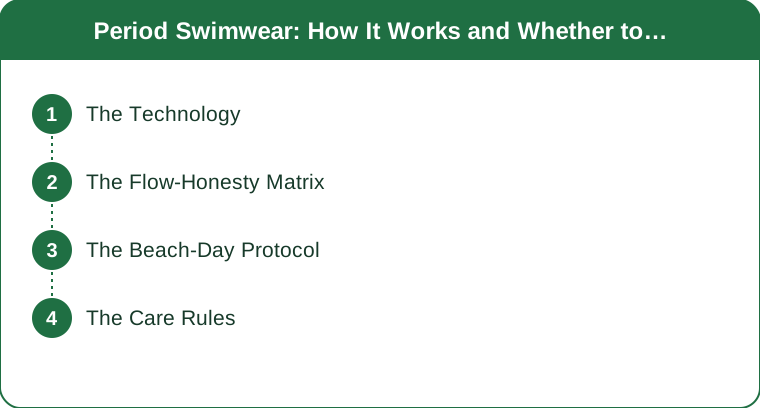
Here’s how it actually works, and the flow matrix that tells you when to trust it at an actual pool.

How does period swimwear work?
Three layers, same principle as period underwear, re-engineered to function submerged.
The wicking liner sits against you and pulls flow inward and away from the skin. The absorbent core holds it — this is the layer doing the actual work, and it’s designed to absorb menstrual fluid while resisting pool water, which is the whole engineering challenge. The leak barrier is a thin waterproof membrane on the outside preventing anything passing through.
The clever part: chlorinated water is thinner and behaves differently from menstrual fluid, and the core is built with a selectivity that lets it take one and largely ignore the other. It isn’t perfect, but it works considerably better than intuition suggests.
Two useful facts about swimming on your period generally. Water pressure genuinely reduces flow while you’re submerged — it’s a real effect, not a myth, and it’s why many people notice almost nothing in the water. And the moment things change is the transition: standing up, climbing out, sitting on the edge. That’s when the pressure releases.
Capacity sits at roughly one to two tampons’ worth for most suits — a light-flow tier. Brands vary, so check the specific product, but that’s the honest ballpark.
Can you trust it without a tampon?
Depends entirely on your flow that day. The honest matrix:
Light days and the tail end of your period: standalone confidence, fully earned. This is what the technology was designed for and it does the job well.
Medium days: suit plus a cup or tampon, with the suit acting as the safety net. This is the configuration that eliminates the anxiety rather than the product — you’re not relying on the suit, you’re backed up by it. Most people find this is where period swimwear actually earns its money.
Heavy days: the suit is backup only. A one-to-two-tampon capacity garment will not hold a heavy day through a swim, a lounge, and a walk to the car. Use a cup or tampon as primary.
Being honest about which day you’re on is the entire trust equation. The technology doesn’t fail people; overestimating the day does.

What’s the beach day protocol?
A few practical things that make the difference between confident and constantly checking.
- Choose darker colors, at least at first. It’s a mental comfort budget more than a functional one, and it costs nothing.
- Watch the post-swim lounge hour. This is the real leak window. Sitting around in a wet suit for an hour after swimming — no water pressure, warm body, absorbed fluid — is when problems happen. Change or re-verify after long soaks.
- Bring a spare. For a full beach day on a medium flow, a second suit in the bag turns a potential problem into a two-minute fix.
- Pack a wet bag. You’ll want somewhere to put the used suit that isn’t your tote.
- Rinse the same day. Chlorine plus menstrual fluid together want attention within hours, not tomorrow.
Myth vs Fact
Myth: Swimming on your period is unhygienic or attracts attention in the water. Fact: Water pressure minimizes flow while submerged, pool chlorine handles sanitation, and there is no shark-related concern in a chlorinated pool or at a beach. This one has no basis.
Myth: Period swimwear is just period underwear that got wet. Fact: It’s a genuinely different construction. Regular period underwear absorbs pool water immediately, saturates, and becomes useless. Swim versions use a core built to reject water while accepting flow.
Myth: You can’t feel it, so it must not be working. Fact: Not feeling it is the intended experience. The layers are thin — usually under 5 mm — and most suits look identical to regular swimwear.
Myth: It lasts forever. Fact: Treated well, two to three seasons. Machine dried once or twice and the waterproof membrane degrades — the suit retires early and quietly, usually without telling you until it leaks.
Care rules
Rinse in cold water immediately after wearing — cold, because hot water sets stains in the absorbent core. Wash gently, either by hand or on a delicate machine cycle, with mild detergent. No fabric softener — it coats the wicking layer and destroys absorbency.
Then air dry, always. The dryer is what kills these garments: heat degrades both the elastic and the waterproof membrane. Line dry in shade, and it’ll serve for seasons.
The technology holds up. The dryer, as ever, does not.
FAQ
Does period swimwear really work in the pool?
Yes, within its capacity. The absorbent core is engineered to take menstrual fluid while resisting chlorinated water, and water pressure reduces flow while you’re submerged. It works reliably on light days and as a backup layer on medium ones; heavy days need a cup or tampon as primary protection.
How much can period swimwear hold?
Most suits hold roughly one to two tampons’ worth — a light-flow capacity. Check the specific brand, as it varies. That’s enough for a swim and some lounging on a light day, and not enough to carry a heavy day through a full beach outing.
How do you wash period swimwear?
Rinse in cold water the same day you wear it, then wash gently by hand or on a delicate cycle with mild detergent and no fabric softener. Always air dry in the shade — machine drying degrades the waterproof membrane and shortens the suit’s life dramatically.
TL;DR:
- Three layers — wicking liner, absorbent core, leak barrier — built to work while submerged.
- Capacity is roughly one to two tampons’ worth, so treat it as a light-flow tier.
- Light days: standalone. Medium days: suit plus cup or tampon as a safety net. Heavy days: backup only.
- The post-swim wet lounge hour is the real leak window — change or re-check after long soaks.
- Rinse cold same-day, no fabric softener, never machine dry.
Keep Reading
This article is for general informational purposes only and is not medical advice. Always consult a qualified health professional for guidance specific to you.