Why Cough Leaks and Workout Leaks Need Different Training
Quick Answer: Leaks during a cough or sneeze are a fast reflex timing problem — the pelvic floor has to contract in milliseconds, before the pressure arrives. Leaks late in a workout are usually an endurance and pressure management problem — the floor is fatiguing or you are breath-holding and driving pressure downward. Both are stress incontinence, but one needs fast, sharp contractions and the other needs holds, breathing mechanics and load management.
A sneeze catches you out. So does the twentieth box jump.
Same symptom, different cause, and if you only train one way you will fix one and not the other.

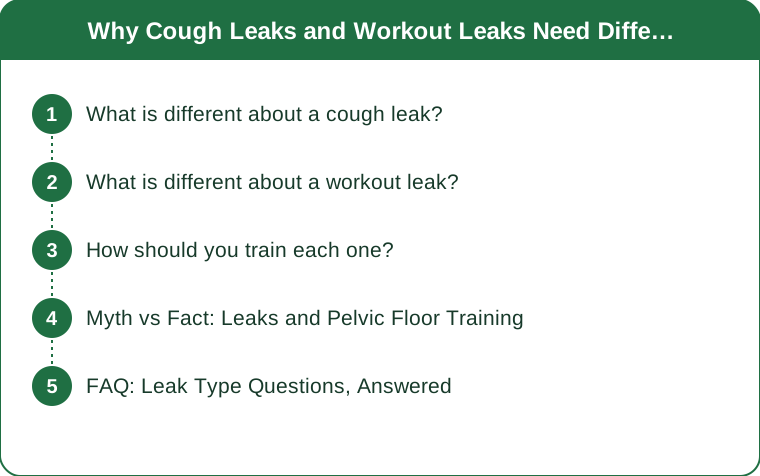
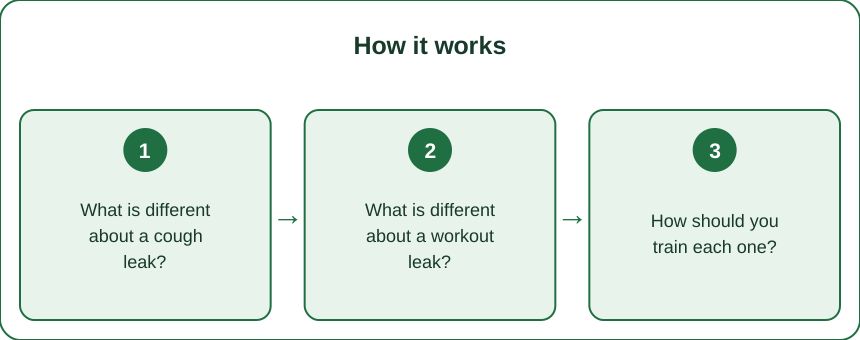
What is different about a cough leak?
The timing window is tiny, and the contraction has to be involuntary.
A cough produces a very fast pressure spike. Intra-abdominal pressure rises and falls within a fraction of a second. There is no time for a conscious contraction.
The healthy response is anticipatory. In a well-functioning system the pelvic floor pre-activates slightly before the cough, not in response to it. This is a reflex, not a decision.
Slow endurance holds do not train this reflex. Ten-second holds build endurance in slow-twitch fibres. A cough needs fast-twitch recruitment and precise timing, which is a different training target.
The fix is fast contractions, sometimes called quick flicks. Short, sharp contractions and complete releases, in sets, train the speed component specifically.
The Knack is the practical bridge. Deliberately contracting just before you cough, sneeze or lift teaches the timing, and with repetition it becomes automatic. Practise it consciously before it can be unconscious.
Posture at the moment matters. Coughing while slumped puts the floor at a mechanical disadvantage. Turning slightly and lengthening the spine before a cough measurably helps for many people.
What is different about a workout leak?
It is usually fatigue and pressure management rather than reflex speed.
Leaks appearing late in a session point at endurance. If minute 5 is fine and minute 25 is not, the muscle is fatiguing. That needs longer holds and progressive endurance work.
Breath-holding drives pressure down. Holding your breath through a rep creates a pressure spike with nowhere to go except the pelvic floor. Exhaling on effort is the single most effective change for many people.
Impact multiplies ground reaction force. Running and jumping generate forces several times body weight, arriving repeatedly. This is a load-tolerance problem, and load tolerance is trainable.
Bracing strategy matters as much as strength. An aggressive downward brace increases pressure on the floor. Learning to brace with the floor engaged rather than pushed down changes symptoms quickly for many people.
A too-tight floor leaks too. This is the most misunderstood part. An overactive pelvic floor that cannot fully relax also cannot fully contract, and more Kegels make it worse. If you have pain, urgency or difficulty relaxing, this is worth assessing before adding strength work.
Overall fatigue matters. Leaks at the end of a hard week when they do not appear at the start of one is a recovery signal, not a pelvic floor failure.

How should you train each one?
Two different programmes, and most people benefit from both with different emphases.
For cough and sneeze leaks: fast work. Ten quick, sharp contractions with a full release between each, two or three sets, most days. Full release matters as much as the contraction.
Practise the Knack deliberately. Contract before every cough, sneeze, lift and laugh for two weeks. It becomes automatic surprisingly quickly.
For workout leaks: endurance and breathing. Holds of 5 to 10 seconds with equal rest, building to 10 repetitions. Plus deliberately exhaling on the effort phase of every lift.
Progress load gradually rather than avoiding it. Reducing all impact indefinitely reduces tissue capacity. Regress to a level where you are dry, then rebuild.
Train both in the same session but separately. Fast work then slow work, not mixed together.
Give it three months. Pelvic floor muscle training has good evidence behind it, but meaningful change typically takes 8 to 12 weeks of consistent practice.
See a pelvic health physiotherapist if you can. A substantial proportion of people perform Kegels incorrectly when self-taught, and one assessment resolves that immediately. Persistent leaking, pain, urgency or prolapse symptoms warrant professional assessment. This is general information, not medical advice.
Seasonal note: cold-weather coughs and colds arriving through autumn make cough-related leaks noticeably worse for a few weeks. Practising the Knack now, before cold season, is well-timed.
Myth vs Fact: Leaks and Pelvic Floor Training
Myth: All leaks are treated with more Kegels. Fact: Some are. Leaks from an overactive, non-relaxing floor get worse with more contraction work.
Myth: Leaking during exercise means you should stop exercising. Fact: It means you should modify load while you build capacity. Long-term avoidance reduces tolerance further.
Myth: It is inevitable after childbirth. Fact: It is common and it is treatable. Common is not the same as normal or permanent.
Myth: Only mothers get it. Fact: It occurs in people who have never given birth, including athletes in high-impact sports, where prevalence is notably high.
Myth: You should stop urine mid-flow to train. Fact: This is a one-off self-test at most and is not recommended as an exercise. Done regularly it can interfere with normal bladder emptying.
FAQ: Leak Type Questions, Answered
How do I know which type I have?
Note when it happens. Sudden spikes — cough, sneeze, laugh — point to reflex timing. Late in a session or with repeated impact points to endurance and pressure management. Many people have both.
What about a sudden desperate urge with no warning?
That is urge incontinence, a different mechanism again, and it responds to bladder training rather than strength work. Worth discussing with a clinician.
How many Kegels a day?
A common protocol is three sets daily combining fast and slow contractions. More is not better, and quality of the release matters as much as the squeeze.
Can I lift heavy at all?
Many people can, with correct breathing and gradual progression. Exhaling on effort and avoiding maximal breath-holds is the key adjustment.
Do pelvic floor trainers and apps help?
They mainly help with consistency and feedback. The exercises are what work; the device is a reminder.
How long before I see change?
Usually some improvement within four to six weeks and meaningful change by twelve, with consistent daily practice.
TL;DR:
- Cough leaks are a reflex timing problem. Train fast contractions and practise the Knack.
- Workout leaks are usually endurance and pressure management. Train holds and exhale on effort.
- A too-tight floor leaks too — more Kegels can make that version worse.
- Modify load rather than stopping. Avoidance reduces capacity.
- Give it 8 to 12 weeks, and get one assessment if you can.
Work out which type you have this week by noting when it happens. The training follows from that.
Keep Reading
This article is for general informational purposes only and is not medical advice. Always consult a qualified health professional for guidance specific to you.