Why You Leak on Jumps but Not on Runs
Quick Answer: Jumping produces a fast, high-magnitude spike in intra-abdominal pressure that the pelvic floor must meet with an equally fast reflexive contraction. Running produces lower peaks repeated many times. Leaking on jumps but not runs usually means your pelvic floor has adequate endurance but inadequate speed and peak strength — a specific gap that responds to specific training, not to more Kegels done slowly.
The pattern of when it happens is diagnostic. Most people never look at it that way.

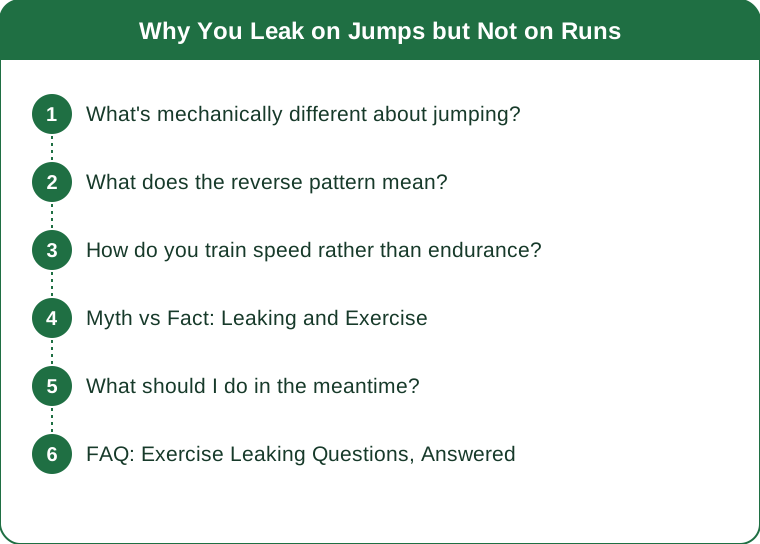
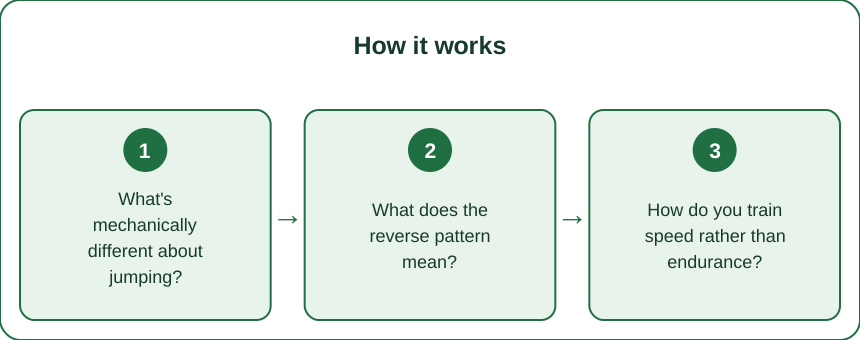
What’s mechanically different about jumping?
The rate and size of the pressure spike, not just the amount.
Landing from a jump generates ground reaction forces of several times bodyweight in a very short window. That force translates into a rapid rise in intra-abdominal pressure.
The pelvic floor has to contract reflexively, ahead of the impact, and fast. This is a pre-activation — it should happen before the landing, not in response to it.
Running peaks are lower — typically around two to three times bodyweight — and more spread out. The demand is repeated but each individual demand is smaller.
So the two activities test different qualities. Running tests endurance. Jumping tests peak force and speed of contraction. A pelvic floor can be perfectly adequate at one and inadequate at the other.
This is why “just do more Kegels” often doesn’t fix jumping leaks. Slow held contractions train endurance — the quality you already have.
What does the reverse pattern mean?
Leaking on long runs but not jumps points at endurance, and it’s a different training answer.
If it starts at mile 3 and not mile 1, that’s fatigue. The pelvic floor is contracting adequately at first and losing capacity as the session goes on.
Endurance work is the answer here — longer holds, more total volume, and attention to overall fatigue management.
Leaking on both suggests a broader strength deficit, and that’s the case most likely to benefit from a full assessment rather than self-directed work.
Leaking on coughs and sneezes but not exercise is another distinct pattern — very fast, very high pressure spike with no preparation. Same speed-of-contraction issue as jumping, in an even more extreme form.
Track it for two weeks: what activity, how far into the session, how much. That log is genuinely useful information for a pelvic floor physical therapist, and most people arrive without it.
How do you train speed rather than endurance?
Quick flicks, and then integrating them into movement.
Quick contractions: contract as fast and hard as you can, release completely, repeat. 10 repetitions, 2 to 3 sets. The full release is as important as the contraction — partial release means you’re building tension, not speed.
Then add a pressure demand. Contract quickly, then cough. This trains the coordination between pelvic floor and the pressure spike, which is the actual functional pattern.
Then add movement, progressively. Heel drops, then small hops, then step-downs, then low box jumps. The progression should be slow enough that you’re not leaking at each stage before moving on.
Breathing is central and usually wrong. Holding your breath through a jump maximizes intra-abdominal pressure. Exhaling through effort reduces it substantially — this alone resolves a meaningful share of cases.
Don’t over-train it. A pelvic floor that’s chronically tight is as dysfunctional as one that’s weak, and it presents similarly. If Kegels make symptoms worse, stop and get assessed.

Myth vs Fact: Leaking and Exercise
Myth: Leaking during exercise is normal after having children. Fact: It’s common. It isn’t normal, and it’s usually treatable. The framing of it as an inevitable cost is why many people never seek care for something with good treatment outcomes.
Myth: You should stop jumping. Fact: Avoidance manages the symptom and doesn’t address the cause, and deconditioning tends to make it worse over time. Modify temporarily while training the gap, then progress back.
Myth: More Kegels is always the answer. Fact: If the pelvic floor is overactive rather than weak, Kegels make it worse. Symptoms overlap enough that self-diagnosis is unreliable. This is the main reason assessment is worth it.
Myth: Only postpartum women experience this. Fact: It occurs in women who’ve never been pregnant, including athletes — it’s notably common in high-impact sports like gymnastics and volleyball. High-impact loading is a risk factor independent of childbirth.
Myth: Emptying your bladder before exercise fixes it. Fact: It reduces volume, which helps somewhat. It doesn’t address the pressure-management problem, and habitually emptying “just in case” can gradually reduce functional bladder capacity.
What should I do in the meantime?
Modify rather than avoid, and get assessed.
Reduce impact temporarily. Step-ups instead of box jumps, single-leg landings instead of double, lower heights. You keep training and remove the trigger while you address it.
Exhale on effort. Breathe out during the jump and the landing rather than bracing and holding. Simple, free, and often immediately effective.
Check your bracing pattern. Aggressive abdominal bracing without pelvic floor coordination drives pressure downward. If you brace hard for heavy lifting, that pattern may be carrying into jumping.
See a pelvic floor physical therapist. This is a specialty with genuinely good outcomes for stress incontinence, and internal assessment distinguishes weakness from overactivity — the distinction that determines whether Kegels help or hurt.
Don’t wait years. Most people delay seeking care for a long time, and earlier intervention generally works better and faster. This is general information, not medical advice.
FAQ: Exercise Leaking Questions, Answered
How long does it take to improve?
With an appropriate program, many people notice change within 6 to 8 weeks and meaningful improvement by 12 to 16. Consistency matters more than intensity — pelvic floor training responds to regular practice, not to occasional hard sessions.
Should I use a pessary or support device?
Some people find internal support devices helpful for sport specifically, and they’re a legitimate option worth discussing with a clinician. They manage the symptom during activity rather than treating the cause, so they work best alongside training rather than instead of it.
Does this get worse with age?
It can, particularly around menopause when tissue changes, but it isn’t a one-way trajectory. Training works at any age, and there’s reasonable evidence that pelvic floor training benefits older women substantially.
Can heavy lifting cause this?
Heavy lifting with poor pressure management can contribute. Well-managed heavy lifting with coordinated breathing and bracing is generally fine and may be beneficial. Technique and progression matter far more than the load itself.
TL;DR: When it happens tells you what to train.
- Jumping = fast, high pressure spike. Needs speed and peak strength of contraction.
- Running = lower peaks, many times. Needs endurance.
- Leaking on jumps only usually means endurance is fine and speed is the gap — slow held Kegels won’t fix it.
- Train quick flicks — fast contract, full release, 10 reps — then add a cough, then add movement.
- Exhale through the jump. Breath-holding maximizes the exact pressure you’re trying to manage.
- Modify, don’t avoid. Step-ups and lower boxes keep you training while you close the gap.
Common isn’t the same as normal, and this responds well to a pelvic floor physical therapist. Track two weeks of when it happens and bring the log.
Keep Reading
This article is for general informational purposes only and is not medical advice. Always consult a qualified health professional for guidance specific to you.