Why Bladder Leaks Show Up During Some Workouts and Never Others, Even at Similar Intensity
Quick Answer: Bladder leaks often show up during specific activities and not others because different exercise types put fundamentally different kinds of load on the pelvic floor — repetitive impact (like running) creates repeated downward pressure spikes that a given pelvic floor may not fully control, while activities without that repetitive impact component, even if similarly strenuous, don’t create the same specific challenge.
It’s not randomness or inconsistency in your body — different workouts are asking genuinely different things of the pelvic floor, and it’s completely normal for one to reveal a weakness the other doesn’t.

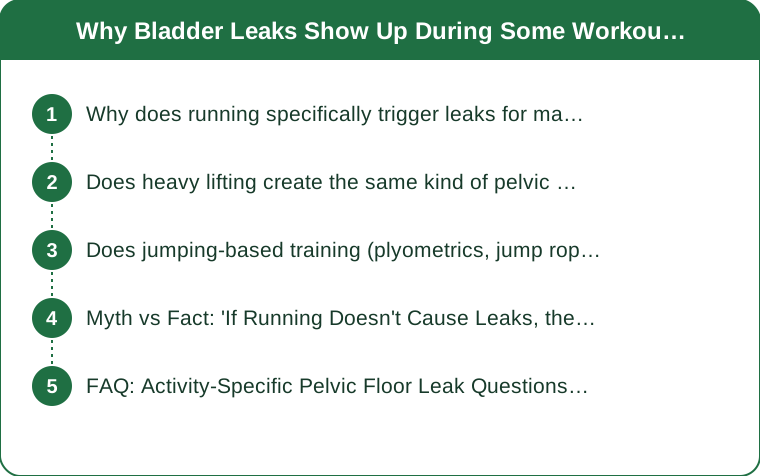
Why does running specifically trigger leaks for many women when other cardio doesn’t?
Running involves repeated impact with each footstrike, creating a rapid, repetitive downward pressure spike on the pelvic floor with every stride — a pelvic floor that can manage a single, sustained pressure challenge (like holding a plank) can still struggle with the fast, repetitive nature of running’s impact pattern, since that’s a genuinely different demand requiring quick, repeated reflexive engagement rather than one sustained contraction.
Does heavy lifting create the same kind of pelvic floor challenge as running, or a different one?
A different one — heavy lifting creates a single, sustained intra-abdominal pressure increase during the lift, rather than a rapid repeated impact pattern, which is why some women notice leaks specifically during heavy lifts (particularly if breathing and bracing technique isn’t well coordinated with the pelvic floor) while having no issue running, and vice versa depending on which specific challenge their own pelvic floor handles less well.

Does jumping-based training (plyometrics, jump rope) present its own distinct challenge too?
Yes, often the most challenging category for many women — jumping combines both the sustained pressure element of lifting-type effort and the rapid, repeated impact element of running, effectively stacking both demands at once, which is part of why jump rope or plyometric-heavy classes are commonly reported as a leak trigger even for women who manage running or lifting individually without issue.
Myth vs Fact: ‘If Running Doesn’t Cause Leaks, the Pelvic Floor Is Fully Fine’
Myth: no leaking during one type of activity means the pelvic floor has no underlying issue at all. Fact: pelvic floor function is activity-specific enough that a clean bill of health during running doesn’t guarantee the same during heavy lifting or jumping — a comprehensive pelvic floor physical therapy assessment, which tests multiple types of load, gives a much more complete picture than judging based on one activity alone.
FAQ: Activity-Specific Pelvic Floor Leak Questions, Answered
Should someone who leaks during running but not lifting still see a pelvic floor physical therapist?
Yes, generally worth it — a PT can assess specifically why the repetitive-impact demand of running is challenging while other loads aren’t, and can target training toward that specific gap rather than assuming general pelvic floor strength alone will resolve it.
Does the specific pattern (running versus lifting versus jumping) change what kind of pelvic floor exercise helps most?
Often yes — building quick, reflexive pelvic floor engagement (sometimes called ‘the knack’) tends to help more with repetitive impact activities like running, while sustained bracing and breath coordination work tends to help more with heavy lifting, reflecting the different demands each activity places on the pelvic floor.
Is it common for the specific triggering activity to change over time, even without new training changes?
Yes — hormonal shifts, postpartum recovery stage, and even simple training volume changes in a specific activity can shift which activity is the most challenging for a given person’s pelvic floor at any point in time.
TL;DR:
- Different workout types place fundamentally different demands on the pelvic floor, not just different intensity levels
- Running’s repeated impact and heavy lifting’s sustained pressure are genuinely distinct challenges
- Jumping-based training often combines both demands, making it a common trigger even when running or lifting alone aren’t
- A comprehensive pelvic floor assessment across multiple activity types gives a clearer picture than judging from one activity
Leaking during one workout but not another isn’t inconsistency — it’s specific, useful information about which exact demand your pelvic floor needs more support handling.
Keep Reading
This article is for general informational purposes only and is not medical advice. Always consult a qualified health professional for guidance specific to you.