Why Leaks Show Up on the Third Set and Not the First
Quick Answer: The pelvic floor is a muscle group, and muscle groups fatigue. Early in a session it can generate the reflex contraction that closes the urethra against a rise in abdominal pressure. After 15 or 20 minutes of repeated pressure spikes, the timing of that reflex slows and the force drops - so the same jump that was fine at minute five leaks at minute twenty.
This is an endurance and coordination problem far more often than a strength problem, which matters because the two need different training.
And it is common, treatable, and not something to plan your life around.

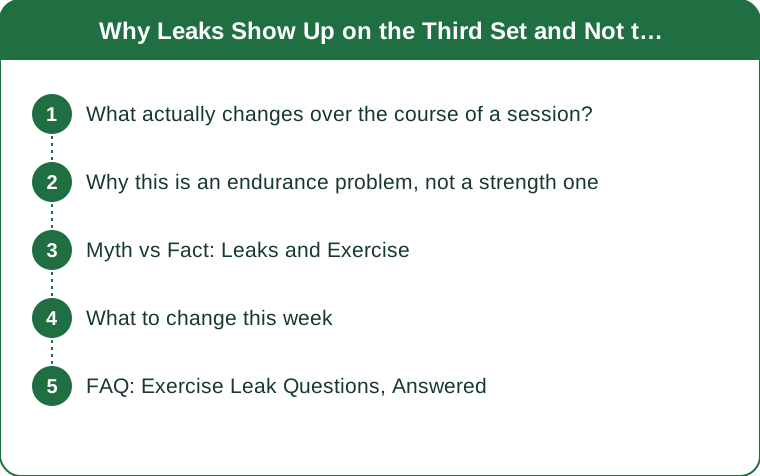
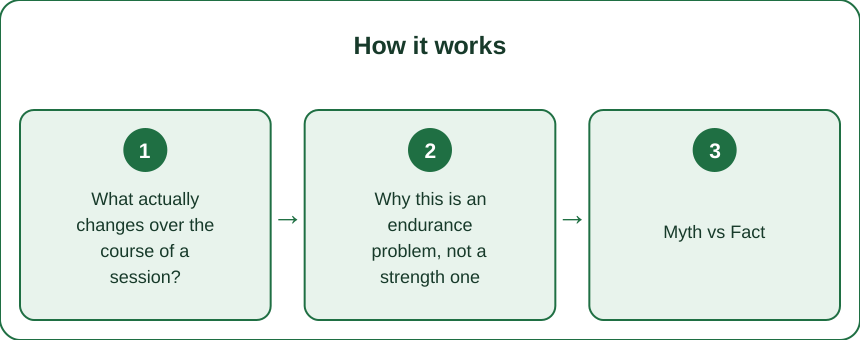
What actually changes over the course of a session?
Three things shift, and they compound.
The reflex gets slower. In a well-functioning pelvic floor, the contraction happens slightly before the pressure arrives - it is anticipatory, not reactive. As the muscle fatigues, that timing slips, and a contraction that arrives after the pressure spike does not do the job. This is why the leak often feels like it came out of nowhere.
The force drops. Standard muscular fatigue. The pelvic floor is largely slow-twitch tissue built for sustained low-level work, and repeated maximal demands are exactly what it is least suited to.
Your breathing changes. Later in a session people hold their breath more and brace harder, which raises intra-abdominal pressure further. You are increasing the load at precisely the moment the muscle is least able to meet it.
Your bladder is fuller. Twenty minutes of drinking during a session, plus the fact that exercise itself reduces the bladder’s tolerance for volume. A fuller bladder needs more closure pressure than an empty one.
And form drifts. As the legs tire, landings get heavier and less controlled, which raises the pressure spike per rep. The third set of jumps genuinely creates more downward force than the first, independent of anything happening in the pelvic floor.
Why this is an endurance problem, not a strength one
The distinction changes the whole training plan, and most people train the wrong one.
Strength is the maximum you can produce once. Endurance is holding a useful contraction repeatedly over 40 minutes. If your leaks happen at minute five, that suggests a strength or coordination gap. If they happen at minute twenty, the strength is clearly there - it just does not last.
Which means long-hold and repeat training matters more than maximal squeezes. Ten maximum-effort contractions does not train the quality you are missing. Sustained submaximal holds and high-repetition quick contractions do.
Coordination is the other half. The pelvic floor works with the deep abdominals and the diaphragm as a pressure system. If you hold your breath and brace down, you are actively working against your own pelvic floor. Learning to exhale on effort is often more effective than any amount of squeezing.
And over-tightness is a real and underappreciated cause. A pelvic floor that is chronically held tight is a fatigued pelvic floor, and it can leak for the opposite reason to the one people assume. If you cannot fully relax it, more squeezing makes things worse - which is why self-directed Kegel programmes sometimes backfire and why an assessment is worth having.
The pattern to notice: if your leaks are late-session, worse when tired, and worse in the week before your period, that is a fatigue and hormonal-load picture rather than a structural one - and it responds well.

Myth vs Fact: Leaks and Exercise
Myth: More Kegels will fix it. Fact: Sometimes, and sometimes they are precisely the wrong intervention. If the floor is already over-tight, adding contractions increases fatigue. This is the main reason an assessment beats a generic programme - roughly a third of people doing Kegels from written instructions do them incorrectly.
Myth: It happens because you had children. Fact: Pregnancy and birth are significant risk factors, and a substantial proportion of people with exercise-related leaks have never been pregnant - including young athletes in high-impact sports, where rates are strikingly high.
Myth: You should stop doing high-impact exercise. Fact: Long-term avoidance deconditions the exact system you need. Temporary modification while you build capacity is sensible; permanent avoidance is not the goal and is rarely necessary.
Myth: Going to the toilet ‘just in case’ before every session helps. Fact: Habitual just-in-case voiding trains the bladder to signal at lower volumes, which makes the problem worse over months. Once before you start is fine; four times is a habit worth breaking.
Myth: It is just a normal part of getting older. Fact: Common is not the same as normal, and it is not something you have to accept. Pelvic floor physiotherapy has strong evidence behind it and is the recommended first-line treatment in most guidelines.
What to change this week
Some of this is immediate and some of it takes three months. Both are worth starting.
Immediately, during sessions:
- Exhale on the effort. Breathe out as you jump, lift, or push. This is the single highest-value change and it costs nothing
- Front-load the high-impact work. Do jumps and plyometrics early in the session while the floor is fresh, rather than at the end as a finisher
- Shorten the exposure. Three sets of 30 seconds with full rest beats one set of two minutes for the same total work with far less cumulative fatigue
- Empty your bladder once, not repeatedly, and moderate fluid in the hour before
- Swap the movement, not the session. Step-ups instead of box jumps for a few weeks - the aim is to keep training while you build capacity
The training, over 8 to 12 weeks:
- Long holds: contract at about 50 percent effort and hold for 10 seconds, 10 times, daily. This is the endurance quality you are missing
- Quick flicks: 10 fast contractions, twice daily, for the reflex speed
- Practise the relaxation as deliberately as the contraction. A full release between reps is part of the exercise, not a rest from it
- Add them to a movement. Contractions while standing, then while squatting, so the skill transfers to the situations that need it
Expect 8 to 12 weeks for meaningful change, and get an assessment from a pelvic health physiotherapist rather than working from a generic plan - particularly if you have pain, cannot feel the contraction, or have been doing exercises for months without change. This is general information, not medical advice.
FAQ: Exercise Leak Questions, Answered
Should I stop running until this is sorted?
Usually not - reducing distance or pace while you build capacity keeps the benefit and lowers the load. Full stops tend to become long stops, and the deconditioning works against you.
Why is it worse some weeks than others?
Cycle phase changes tissue laxity and fluid balance, and the days before a period are the most commonly reported bad window. Sleep and general fatigue also show up here more than people expect.
Does a pessary or support garment help during workouts?
For some people, considerably - and they are worth discussing with a clinician rather than trying to work out alone. They are a support while you build capacity, not a replacement for it.
Is it normal for this to appear in my forties without any obvious cause?
It is common in that window, largely because of hormonal changes affecting tissue quality. Common does not mean untreatable, and this is exactly the group that responds well to a structured pelvic floor programme.
TL;DR:
- Late-session leaks are pelvic floor fatigue - the reflex slows and the force drops
- It is an endurance and coordination problem more often than a strength problem
- Breath-holding, a fuller bladder, and heavier landings all compound it as you tire
- Exhale on effort, put high-impact work early, and shorten exposure with more rest
- Train long holds and quick flicks daily, and get assessed rather than guessing
Next session, put your jumps at the start instead of the end and breathe out on every landing. If that changes things, you have your answer.
Keep Reading
This article is for general informational purposes only and is not medical advice. Always consult a qualified health professional for guidance specific to you.