Why Leaks Start Happening on Runs but Not in the Gym
Quick Answer: Running creates repetitive downward impact forces roughly two to three times body weight, arriving 160 to 180 times per minute, while gym lifts produce higher peak but far fewer, more controlled loads. The pelvic floor manages occasional high loads better than sustained rhythmic ones — especially once breath rhythm and fatigue degrade the reflexive contraction that normally fires before impact.
Squats at a challenging weight: fine. Planks: fine. Spin class: fine.
Mile two of an easy jog: not fine.
That inconsistency confuses a lot of people into thinking the problem is random. It is not — running asks a genuinely different question of the pelvic floor than lifting does.
This is general information, not medical advice.

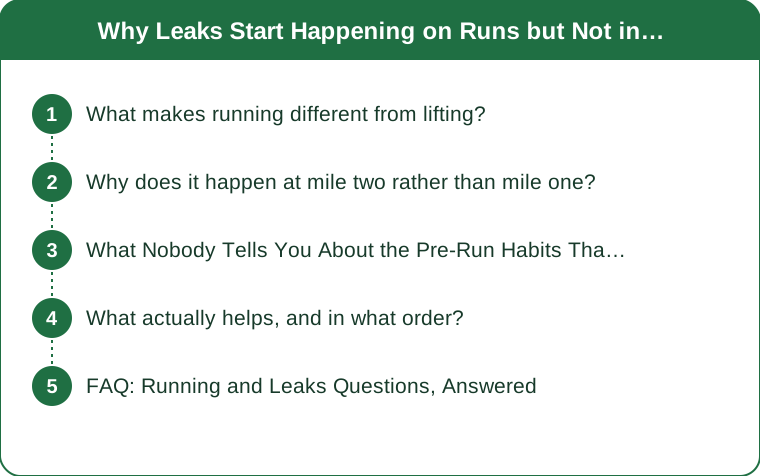
What makes running different from lifting?
Three things stack.
Repetition. At a typical cadence you are absorbing 160 to 180 impacts per minute. Over 20 minutes that is more than 3,000 loading events. A heavy set of squats is five. The pelvic floor’s reflexive pre-contraction is excellent at handling a few big demands and much less reliable across thousands of small ones, because it fatigues like any other muscle.
Timing. In a lift, you can consciously brace before the load. In running, the pre-contraction has to be automatic and precisely timed to foot strike. When fatigue delays that timing by even a fraction, the load arrives before the support does.
Breathing. Lifting uses a held brace. Running requires continuous breathing, and breath and pelvic floor are mechanically coupled through the diaphragm. Breath-holding or shallow chest breathing during a run disrupts the coordination that keeps intra-abdominal pressure managed.
Why does it happen at mile two rather than mile one?
Because it is a fatigue threshold, not a switch.
Mile one, the reflexive contraction is firing on time. Somewhere between mile one and three for many people, local endurance in the pelvic floor and deep core declines enough that the timing slips. The load has not changed; the support has.
This is genuinely useful information, because it means the training target is endurance, not maximum strength. Doing ten maximal Kegels is training the wrong quality. Holding submaximal contractions for longer durations, and doing them under breathing load, matches what running actually demands.
Other factors that move the threshold earlier:
- Being in the days right before or during your period, when tissue laxity shifts
- Running late in the day after a long time on your feet
- Dehydration paired with concentrated urine, which is more irritating to the bladder
- Downhill running specifically, which increases eccentric impact substantially

What Nobody Tells You About the Pre-Run Habits That Backfire
Two extremely common habits make things worse, and both feel responsible.
Just-in-case voiding. Emptying the bladder repeatedly before a run seems sensible, but doing it habitually at low volumes trains the bladder to signal urgency earlier over time. Go before you run, once. Not three times.
Cutting fluids before a run. Concentrated urine irritates the bladder lining and can increase urgency. Being underhydrated also degrades muscular endurance everywhere, including the pelvic floor. Drink normally.
Two more worth knowing:
- Caffeine within about 90 minutes of running increases urgency for many people. If your leaks cluster on morning runs after coffee, that is a variable worth testing.
- Sucking in your stomach while running raises intra-abdominal pressure and pushes down rather than supporting. A relaxed, gently engaged midsection manages pressure better than a braced one.
None of these are the whole answer, but they are free to change and often move the needle within a week.
What actually helps, and in what order?
Start with the things that are within your control this week, and get assessed if it persists:
- Cadence. Increasing step rate by roughly 5 to 10 percent reduces peak impact per step meaningfully. A metronome app at 170 to 180 steps per minute is the simplest intervention available.
- Breathe out on impact-heavy efforts. Exhaling on effort keeps pressure managed; breath-holding does the opposite.
- Endurance-focused pelvic floor work. Submaximal holds of 20 to 30 seconds, repeated, plus quick reflexive contractions. Endurance and speed, not just strength.
- Run-walk intervals to stay under the fatigue threshold while building capacity — four minutes running, one walking, extending the running block weekly.
- Strength work for glutes and deep core, which share the load-management job with the pelvic floor.
- See a pelvic floor physical therapist if leaks persist past six to eight weeks of consistent work, or at any point if there is pain, heaviness, or pressure. Some pelvic floors are too tense rather than too weak, and Kegels make that group worse — which is exactly why an assessment beats guessing.
Leaking during exercise is common. Common is not the same as something you have to accept.
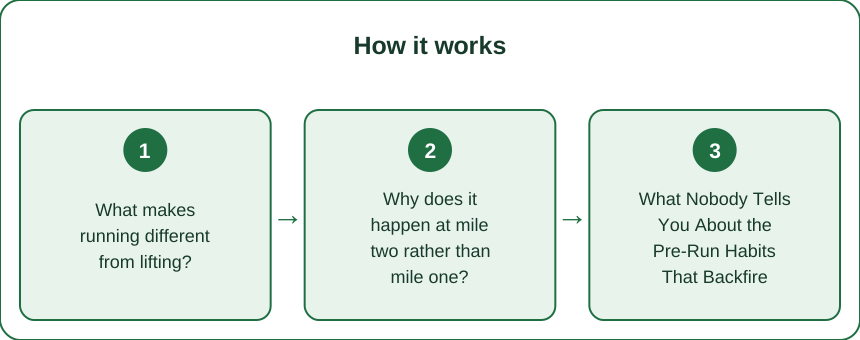
FAQ: Running and Leaks Questions, Answered
Should I stop running until it is resolved?
Usually not. Modifying — shorter intervals, flatter routes, higher cadence — preserves fitness while you build capacity. Complete rest rarely fixes a timing and endurance problem.
Do Kegels always help?
No. If the pelvic floor is hypertonic, strengthening exercises can increase symptoms. That is the main reason a proper assessment is worth it before committing to a program.
Does it get worse with age or is that a myth?
Prevalence rises with age and with childbirth history, but it is highly responsive to training at any age. Trajectory is not destiny here.
TL;DR:
- Running delivers thousands of moderate impacts; lifting delivers a handful of controlled big ones
- Leaks at mile two indicate an endurance and timing threshold, not weakness alone
- Raise cadence 5 to 10 percent, exhale on effort, and skip just-in-case voiding
- Train endurance holds and quick reflexive contractions; get assessed if it persists past six to eight weeks
Try a metronome at 175 steps per minute on your next easy run. It is the cheapest thing on this list and often the most effective. General information, not medical advice.
Keep Reading
This article is for general informational purposes only and is not medical advice. Always consult a qualified health professional for guidance specific to you.