Why Your Warm-Up Changes Leak Risk More Than the Workout Does
Quick Answer: The pelvic floor works reflexively, contracting a fraction of a second before impact loads it. That reflex is slower when the muscles are cold and when you have gone straight from sitting to jumping. A warm-up that includes breathing and progressive impact gives the reflex time to come online, which is why leaks cluster in the first ten minutes of a session and often disappear afterward.
You leak in the first few minutes of class and then you are fine for the rest of it.
That pattern is so common it is almost diagnostic — and it points at the warm-up, not the workout.

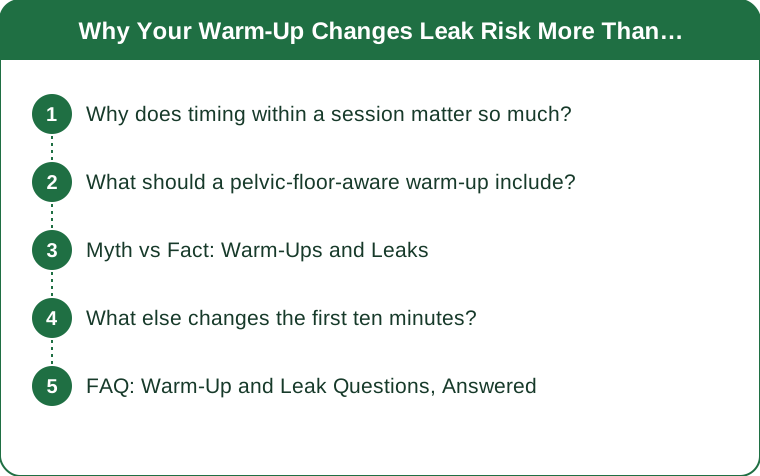
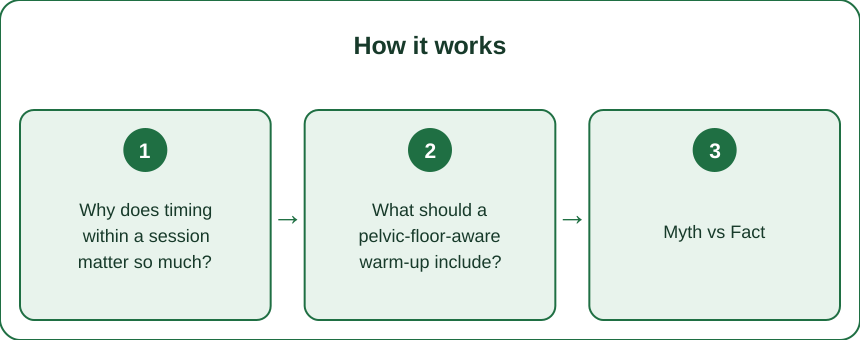
Why does timing within a session matter so much?
Because the pelvic floor is a reflex system, and reflexes have a warm-up curve like everything else.
The contraction is anticipatory, not reactive. In a well-coordinated system, the pelvic floor and deep abdominals contract slightly before the load arrives — before the foot lands, before the cough, before the lift. That timing is measured in fractions of a second, and it is trainable.
Cold muscle contracts later and less forcefully. This is true of every muscle and there is no reason the pelvic floor would be exempt. Going from a car seat to a jumping jack gives the system no opportunity to get its timing right.
Sitting beforehand makes it worse. Prolonged sitting reduces pelvic floor activity and can leave the muscles both shortened and less responsive. A workout that follows eight hours at a desk starts from a worse position than one that follows a walk.
Fatigue produces a second window later. Leaks at the end of a long session are a different mechanism — that is fatigue, not cold. If yours happen at minute 40 rather than minute 4, the answer is volume management, not a warm-up.
Knowing which window yours falls into tells you which fix applies, and most people have never separated the two.
What should a pelvic-floor-aware warm-up include?
Three stages, about six to eight minutes total, and none of it looks unusual in a gym.
Stage one: breathing, two minutes. Slow diaphragmatic breaths, ideally lying or seated. The diaphragm and pelvic floor move together — the pelvic floor lengthens on the inhale and recoils on the exhale. Re-establishing that rhythm before you load anything is the piece almost everyone skips.
Stage two: gentle activation, two minutes. A few slow, deliberate pelvic floor contractions coordinated with the exhale, then a few quick ones. The quick contractions matter specifically, because the reflex you need for impact is a fast one, and slow holds do not train it.
Stage three: progressive impact, three minutes. This is the missing link. Go from marching, to heel raises, to small hops, to full jumps — each for thirty seconds. You are giving the reflex progressively larger loads to calibrate against instead of asking it to handle a full jump cold.
Then start the session. For a lot of people this alone moves the leak from minute three to never, and it costs less time than the first water break.
Empty your bladder beforehand, but not repeatedly. Once, before you start. Going just in case several times trains the bladder to signal at lower volumes, which makes the underlying problem worse over months.

Myth vs Fact: Warm-Ups and Leaks
Myth: Leaks mean your pelvic floor is weak. Fact: Sometimes. But timing and coordination problems are at least as common, and a pelvic floor that is too tight to lengthen and recoil properly leaks too. Doing more strengthening on an already tight floor can make it worse, which is why self-diagnosing here is risky.
Myth: More kegels before a workout will prevent it. Fact: Fatiguing the muscle group right before you need it is counterproductive. A few coordinated contractions is a warm-up; fifty is pre-fatigue.
Myth: If it stops after ten minutes, it is not a real problem. Fact: It is real, it is common, and it is highly treatable — but it is not something to accept as normal. Common and normal are not the same word.
Myth: You should just avoid the exercises that cause it. Fact: Long-term avoidance narrows what you can do and does not address the coordination. Temporary modification while you work on it is sensible; permanent avoidance is not the goal.
Myth: It is only a postpartum issue. Fact: It shows up in people who have never been pregnant, particularly in high-impact sport, and it becomes more common around perimenopause. The mechanism is the same either way.
What else changes the first ten minutes?
A few things that stack on top of the warm-up itself.
What you drank in the last hour. Caffeine is a bladder irritant and increases urgency independent of volume. A coffee 45 minutes before class is a meaningful contributor, and it is more about the caffeine than the fluid.
How full your bladder is. An overfull bladder raises the pressure the system has to manage before you have done anything. Empty once, roughly 15-20 minutes before starting.
Breath-holding. Holding your breath during effort spikes intra-abdominal pressure downward onto the pelvic floor. Exhaling on exertion is the single most useful in-session habit, and it matters most on the first few hard reps when you are still finding your rhythm.
Cold environments. A cold studio increases urgency and stiffens tissue. Keeping a layer on for the warm-up is not vanity.
Where you are in your cycle. Symptoms fluctuate with hormonal changes across the month for many people, and knowing your own pattern lets you plan higher-impact sessions for the weeks that tolerate them better.
This is general information, not medical advice. Pelvic floor symptoms are highly treatable, and a pelvic floor physical therapist can assess whether yours is a strength, timing, or tension issue — which matters, because the treatments differ. Persistent leaking, pain, or heaviness deserves a professional evaluation.
FAQ: Warm-Up and Leak Questions, Answered
How long before the warm-up starts working?
Many people notice a difference in the first session or two, because the immediate effect is about coordination rather than strength. Lasting change in the underlying issue takes longer — typically several weeks of consistent work, and faster with professional guidance.
Should I do this before every workout or only high-impact ones?
Before anything with impact or heavy loading. For a walk or gentle yoga it is unnecessary. The progressive impact stage specifically matters for running, jumping, plyometrics, and heavy lifting.
Does this replace pelvic floor training?
No. It makes the sessions you already do more comfortable, but it is a warm-up, not a program. If leaks are a regular part of your training, a proper assessment is worth far more than any warm-up routine — including this one.
TL;DR:
- The pelvic floor contracts reflexively just before impact, and that reflex is slower when cold
- Leaks in the first ten minutes are a warm-up problem; leaks at minute 40 are a fatigue problem — they need different fixes
- Warm up in three stages: breathing, quick coordinated contractions, then progressive impact from marching to jumping
- Exhale on effort, empty once beforehand, and watch caffeine timing more than water volume
Common is not the same as normal. A warm-up buys you a lot of comfortable sessions, and a proper assessment fixes the thing underneath it.
Keep Reading
This article is for general informational purposes only and is not medical advice. Always consult a qualified health professional for guidance specific to you.